I’m having such a good time reading White Oleander. You might have seen the movie when it came out in 2002, but the book is really worth reading. The story follows the heroin, Astrid through intense experiences as she makes her way from foster home to foster home. Though the plot itself has absorbed my attention, I am mostly delighted with how great a job the author Janet Fitch has incorporated art and its beauty as a means of healing Astrid’s emotional and physical wounds. The references are spot on, and for the art junkie, it’s also really cool to catch these references and understand. Right now, I’m reading about how Astrid is going through a Kandinsky phase, but I’ll leave the rest for you to find out. I hope you enjoy!
Wednesday, July 15, 2009
Wednesday, July 8, 2009
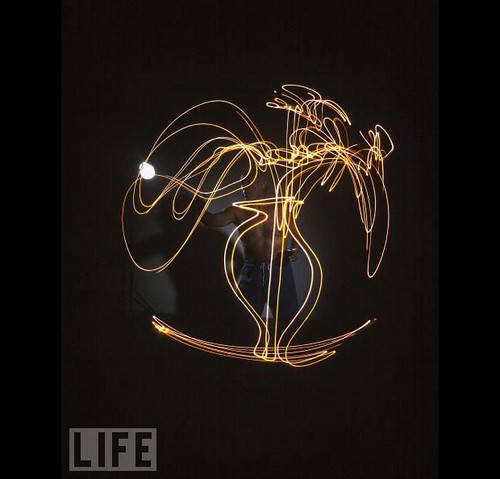
Picasso: Drawing with Light
Today, rather than share with you what I recently read in a book, I'm going to share an image feed of a series of pictures that I came across in Life Magazine.
via Life.com:
LIFE photographer Gjon Mili visited Picasso in 1949. Mili showed the artist some of his photographs of ice skaters with tiny lights affixed to their skates jumping in the dark—and Picasso's mind began to race. The series of photographs that follows—Picasso’s light drawings—were made with a small flashlight in a dark room; the images vanished almost as soon as they were created.


Labels:
Gjon Mili,
LIFE,
light drawings,
modern art,
photography,
Picasso
Wednesday, July 1, 2009
The Gardner Heist: The True Story of the World's Largest Unsolved Art Theft
Visiting the museum is really a calming experience, especially sitting by the courtyard with pretty plants growing and blooming year round. Just beware of the guards surrounding the place. They keep an extremely tight eye on all visitors, making sure there is no funny business going down. The tight security is actually the result of a heist at the museum in 1990, where thieves escaped with invaluable art including three Rembrandts and one Vermeer. To this day, the robbers still have yet to be caught, and we still have no idea where the art is.
This robbery forms the plot of the book, The Gardner Heist by Ulrich Boser. A journalist turned amateur sleuth, Boser takes the reader through his investigation as he pursues leads and collects a wealth of clues. It was such an entertaining read that solving the actual mystery become secondary to the narrative.
Labels:
art museums,
Boston,
Massachusetts,
mystery,
robbery
Wednesday, June 24, 2009
Chromophobia

The list of phobias is rather extensive and exhaustive, ranging from the fear of sitting down (kathisophobia) to the fear of relatives (syngenesophobia). A lot of phobias probably seem a little ridiculous (like the ones I mentioned), but the title phobia of David Batchelor's book, Chromophobia, is a fear that afflicts more people than you would think.
By definition, chromophobia is the fear of colors. In a series of essays, Batchelor explores Western culture's aesthetic propensity in avoiding the use of color, a trend that he disagrees with, evinced by book's brightly colored cover. Batchelor is thoughtful in his argument, drawing references from Herman Melville's "great white whale," Le Corbusier's architecture, and galleries' use of white space, among others.
Well-written and concise, Chromophobia is a fun delve into art theory.
Wednesday, June 17, 2009
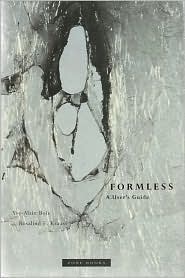
Formless: A User's Guide
For anyone interested in modern art, Formless should be the textbook of choice. Authors Yve-Alain Bois and Rosalind E. Krauss introduce a range of concepts in understanding avant-garde and modernist art practices. They further explore the term, informe, originally developed by Georges Bataille, arguing for its importance in twentieth-century culture. Especially now, when art is appreciated aside from its formal mastery, the re-conceptualization of the modern world of art in terms of the formless makes for a fascinating read. This book has me thinking about Jackson Pollock or Claes Oldenburg from a completely new perspective.
Labels:
art history,
claes oldenburg,
Formless,
jackson pollock,
modern art,
textbook
Thursday, June 11, 2009
Towards an Architecture

I’ve been really into architecture lately, doing a lot of reading related to the art of architecture.
For the most part, we associate architect Le Corbusier with his modernist home, the Villa Savoye. However, he is also the author of the seminal book, Towards an Architecture (Vers une Architecture in French), detailing his belief in modern architecture and the direction that modern architecture should follow. Because of the 20th century’s association with the machine age, Le Corbusier believed that architecture should also be a product of mechanical reproduction, thus rejecting historical references and traditional materials. A memorable quote from the book: “a house is a machine for living.”
Wednesday, June 3, 2009
Ways of Seeing

Ways of Seeing by John Berger remains as one of the canonical works in art literature. The book, based off the BBC television series of the same name created by Berger with Mike Dibb, was written over 30 years ago, though what Berger had to say about the prevalence of visual imagery in our day-to-day lives still remains as recognized as ever. I wasn’t alive in the 1970s to watch the series, but I read a few assigned chapters as a student, and I remember being blown away by what he had to say, and how simply he said it. It’s a short read, and I look forward to reading through the book in its entirety.
Labels:
art,
BBC,
John Berger,
literature,
Mike Dibb,
public programming,
visual imagery,
Ways of Seeing
Subscribe to:
Posts (Atom)