Tuesday, June 22, 2010

"Work of Art: The Next Great Artist" : A Watch-Worthy Television Show


I know it's not an art text, but a recent Bravo television show has caught my interest (more than any art book I've read or heard about in the past few weeks), so I thought I'd deviate from the norm and discuss the new hit show.

"Reality Television" are two words that usually make me cringe. I am not entertained by wanna-be celebrities duking it out on a private island or trashy Jersyites documenting their days spent at the tanning salon and showing off their"Situations" on the boardwalk.

But, I do like to think of myself as open-minded, and as an art-lover, I felt the show deserved a chance. After watching two episodes of "Work of Art: The Next Great Artist" I eagerly await the third one (and the entire season for that matter). Similar to one of the few reality television shows I do watch, "Project Runway" (in which fashion designers compete in various elimination-style challenges for a chance to show their line at NY Fashion Week and a large cash prize), "Work of Art" started off with over a dozen hopeful contestants (artists with differing backgrounds, educations, art experience and artistic styles - ranging from representational to conceptual, etc) eager to show off their talents. "Work of Art" eliminates one artist each week, based on how they perform in the challenge (a time-sensitive, limited-resource, art-related task).

The fashionable actress, New Yorker, and self proclaimed art-enthusiast Sarah Jessica Parker is one the executive producers of "Work of Art," which will reward its winner with a solo show at the Brooklyn Museum along with a hefty $100,000 prize.

I like the non-snooty aspect of the show and the universal quality (you don't need to know much about art to understand, appreciate and enjoy "Work of Art"). The judges are honest and detailed in their critiques, which is refreshing (and educational). Famed art critic Jerry Saltz is a judge, along with China Chow (who's also the show's host), Bill Powers and Jeanne Greenberg Rohatyn. Simon de Pury, chairman of the world-renowned auction house Phillips de Pury and Company, acts as the mentor for the contestants, giving them feedback as they create in the studio (if you watch "Project Runway," consider Simon the Tim Gunn of "Work of Art").

In all, the show is engaging (I shout out my thoughts and nod in agreement along with the judges as if I'm one of them), the characters are intriguing (I'm rooting for the OCD installation artist, Miles) and the art is diverse and unique (which to me, shows that the weekly challenges are well thought out and broad enough to allow for many different interpretations).

Check it out on Bravo, Wednesdays at 10pm Central Time.

See what the NY Times has to say about "Work of Art"

Wednesday, May 12, 2010

Street Art San Francisco: Mission Muralismo

San Francisco's unique Mission District, a haven for street art - and art in general for that matter, contains the world's largest concentration of public paintings. The vibrant Street Art San Francisco: Mission Muralismo (Annice Jacoby) explores and showcases the district's street art - an array of boldly painted images and murals that embody and embrace activism, culture, passion and the desire for social change.

During the early 1970s the city's legendary Mission District transformed into an art epicenter - crossing popular culture, fine art, and political audiences. "Mission Muralismo," as the movement is termed, is an ongoing and ever-changing movement that combines elements of Mexican mural painting, surrealism, pop art, urban punk, eco-warrior, cartoon and guerilla graffiti that has catapulted many San Francisco artists into the spotlight of the international art world.

The book, which features over 500 full-color photographs, also contains in-depth commentary by artists who have been part of "Mission Muralismo" and that of Mission-savvy writers. The 30 essays expose the 3+ decades of the expansive public art movement of San Francisco. Among others, R. Crumb, Shepard Fairey, Swoon, Barry McGee (TWIST), Rigo and Spain Rodriguez, have commented on street art and the movement in Street Art San Francisco: Mission Muralismo. Additionally, the book contains a forward by Grammy Award Winner Carlos Santana, who states,

"The whole Mission neighborhood is a massive public artwork, both sacred and profane, brimming with graff and goddesses."

Click here to buy the book

Click here to see what's going on in San Francisco's dynamic art scene

Friday, April 2, 2010

Going Gaga for Lady Gaga

Stefani Joanne Angelina Germanotta, AKA Lady Gaga, is an American recording artist turned international music sensation. The 24-year-old musician began performing in the rock music scene of NYC's Lower East Side after dropping out of NYU's prestigious Tisch School of the Performing Arts. In 2007 she signed with Streamline Records (an imprint of Interscope Records). Her seemingly overnight rise to fame began with her aptly titled debut album, "The Fame," released in August of 2008.

Gaga's eccentric performances - complete with over-the-top costumes and sets, as well as her glam rock and pop infused music have allowed Lady Gaga to explode onto the contemporary music scene; the artist has sold 10 million albums, plus 35-million singles worldwide.

The Overlook Press recently published the starlet's biography, titled "Lady Gaga: Behind the Fame." Written by Emily Herbert, the book profiles the NYC-born Lady Gaga, a dynamic and talented go-getter who has said,

"I make music and art and design all day long. Yes, I wash my face and go to sleep but when I wake up, I am always Lady Gaga."

Overlook Press publicist Leslie Brandon describes Lady Gaga as "an Upper East Side girl with a downtown attitude." The former outcast has become a fascinating spectacle - skyrocketing to the top of the music charts, charming the pants off the fashion world and securing her place in pop culture history.

"Lady Gaga: Behind the Fame" contains 23 pages of color photographs and details Gaga's inspiring journey from student to superstar, from Stefani Germanotta to Lady Gaga: Classically trained on the piano since age 4. Other highlights of the biography include Gaga's high school experiences with Paris and Nicky Hilton, her meeting and performing for the Queen of England, discussions of gay rights, as well as Gaga's riotous loyal fan base, which the star affectionately calls her "little monsters."

Click here to read more about the #1 hit-maker's biography and purchase a copy.

Monday, March 1, 2010

International Contemporary Masters Volume III

World Wide ArtBooks has recently released its International Contemporary Masters Volume III, which traces the current art world’s latest trends and features the work of select international artists who are helping to mold the evolution of the contemporary art world. International curator and founder of World Wide ArtBooks Despina Tunberg produced the book with the goal of showing that innovation in art is still thriving around the globe.


Greek born Tunberg, who owns galleries in both Europe and the U.S., recognized how artists can spend time struggling to show their art, when they would rather spend time creating it. She created the International Contemporary Masters series as a luxury art publication that would allow artists to introduce their world to the art world. Her books include well known and lesser known artists, all of whom are extremely talented and innovative.


The newest volume features some 400 images of artwork from over 230 artists. Nearly 50 countries’ artists are represented, and each artist was selected by a special committee that adhered to strict criteria of originality and proficiency. Editors sought the inclusion of artists who have broken new ground – even if the artists haven’t yet been discovered by the art world at large. Media presented in the book includes painting, mixed media, sculpture, photography, digital art and installation.


Click here to read more about the book, how Tunberg supports artists beyond including them in her publication, and about World Wide ArtBooks.

Monday, February 1, 2010

Biggest Book in the World on Display

While it's not necessarily a "read-worthy art text," the 350 year-old Klencke Atlas is definitely a "view-worthy art text." The colossal book is five feet tall and six feet wide; it was given to the king by Dutch merchants and placed in his cabinet of curiosities. The Atlas, which has never publicly been displayed with its pages open, will be on view this summer at the British Library. The summer exhibition is dedicated to maps and will be showing about 100 of the world's greatest - about three-quarters of which have never before been on display.


Peter Barber, the British Library's head of map collections, recently stated,

"...[the maps] hold their own with great works of art. This is the first map exhibition of its type because, normally, when you think of maps, you think of geography, or measurement or accuracy."

Furthermore, the exhibition will show how great maps are often as important as great art. They were important status symbols, especially before the 1800s, and were considered to be almost as prominent as paintings, sculptures and tapestries.

Visit the Guardian to read more on the history of maps and other types of maps that will be on display at this summer's unique exhibition.

Tuesday, January 12, 2010

A Noteworthy Book on the Bauhaus School

"The Bauhaus Group: Six Masters of Modernism," by Nicholas Fox Weber, details the life and works of famed architects Walter Gropius and Ludwig Mies van der Rohe; painters Paul Klee, Wassily Kandinsky and Josef Albers, and weaver and textile designer Anni Albers (Josef's wife).

Begun by WWI lieutenant Walter Gropius of the German Army, the Bauhaus school, which included a mix of architects, painters and master artisans of various crafts, sought an integration between the art and industrial worlds to benefit humanity. His conception included ideas about reconciling beauty, simplicity, utility and mass production (which was completely different from the contemporary standard of decorative elaboration). The school only lasted from 1919 until 1933 and faced constant opposition during its existence in Germany. However, the Bauhaus initiated global changes in the art and craft realms.

Weber's book explores six of the school's most influential people. In a recent NY Times Book Review, the author is quoted as saying,

"In focusing on six of the people at the school who went far beyond the issues of one period or place, and were geniuses for all time, and in trying to sketch them as human beings, I have attempted to show how they created and lived out a dream that was never equaled before or since."

The author is a specialist in writing biographies about artists; he is the author / co-author of six previous volumes about Josef and Anni Alberses (who he met while studying fine art during graduate school at Yale).

Tuesday, December 15, 2009

"Painting Below Zero: Notes on a Life in Art"

The term "Pop Art" is defined as a visual art movement that challenged tradition (first during the mid-1950s in Britain and then in the late 1950s in the U.S.) by asserting that an artist's use of the mass-produced visual commodities of popular culture is contiguous with the perspective of fine art. Case in point: the most well-known American Pop Artist, Andy Warhol, silk-screened a seemingly non-iconic image of a Campbell's soup can onto a canvas and voila, the public became fascinated with the Campbell's Soup image (and the product itself).

As a recent review from the NY Times discusses, James Rosenquist penned "Painting Below Zero: Notes on a Life in Art," an autobiography about the artist's accidental status as a pop artist (as a Midwest painter whose work happens to thematically parallel that of Warhol). Rosenquist started his art career as a sign painter and didn't initially meet Warhol or Roy Lichtenstein until 1964 (after Warhol and Lichtenstein had individually developed their avant-garde styles).

The artist's book contains a detailed biography (including his various art-world experiences), along with photographs (like the one below of the artist standing with his proud mother below his first billboard painting - for Coca-Cola), and various anecdotes. Rosenquist acquired the assistance of David Dalton (a founding editor of Rolling Stone Magazine) as well as Tony Scherman (a veteran music journalist) on his book.


To read the entire article from the NY Times - including more about Rosenquist's autobiography and life, art critic Arthur C. Danto's new pop-art related book, and discussion on new definitions / explanations of "Pop Art," click here.

Monday, November 23, 2009

Tattoos as Art

The art world is constantly evolving - and thus, the definition of art (or maybe just that of "contemporary art") continues to broaden. While tattoos were once considered taboo, or an act of rebellion against conformity, getting permanently inked with body art has turned into a pretty widespread occurrence (at least in the Western world).

Tattoos are now frequently accepted as a form of self-expression, but even more interesting are those who actually create the tattoos and ink them onto bodies. It seems that the growth of acceptance of tattoos has allowed tattooists to be viewed as artists and tattooing - like painting or sculpting - to inch its way to being considered a standard form of art.

More and more contemporary tattooists have fine-arts backgrounds - and many have developed their own unique artistic styles, with their tattoo parlors now resembling specialized art studios and galleries.

Accordingly, the market for tattoo-themed books has expanded over the past several years. One recently published book, Art by Tattooists: Beyond Flash by Jo Waterhouse, is unique among the category.

Tattooist Jo Waterhouse examines drawings and paintings by tattoo artists independent of the bodies they are permanently attached to. Thus, without the images of tattooed bodies, the viewer sees the tattoo as a true piece of art (and can subsequently judge it purely as art, rather than thinking of it as a tattoo).

To read more about Jo Waterhouse's book, click here.

Tuesday, November 3, 2009

The Letters: A Culmination of the Van Gogh Museum's Fifteen-Year Project


The newest edition of Vincent Van Gogh's letters is a pinnacle of achievement for Amsterdam's Van Gogh Museum. The 15-year project, which includes almost one-million words, over 4,000 illustrations and has been published in six volumes, has trumped earlier editions by putting the letters in correct chronological order. The new edition includes more accurate translations and detailed annotations, and it truly transforms our current knowledge and understanding of the famed artist.

With almost all of Van Gogh's illustrations now identified (unlike previously, when the lesser known works had remained unidentified), full annotations - with footnotes and references, as well as the inclusion of other important details - like topography, customs, and historical context - The Letters are remarkably detailed and chillingly revealing.

As an article from The Art Newspaper states,

Although most letters were published in earlier editions, some lines were left out for a variety of reasons. For instance, one delightful and telling phrase was omitted simply because it had been crossed out by Van Gogh. On 7 December 1883, while living with his parents in Nuenen, he had written: “People are like brushes—the ones that look the best do not work the best.” This very much reflected his philosophy, and his family often criticised his scruffy clothes.

Sometimes details were withheld, even as late as in the 1958 edition, because they were still sensitive to the family. For instance, in Van Gogh’s unsent letter to Theo and his wife Jo of 7 July 1890, in the last month of his life, the words “while there are disagreements between you” were omitted...

...The most important completely new discovery is a letter from Van Gogh to his former boss at Goupil’s gallery in The Hague, where he had his first job. Van Gogh is said to have eventually written up to 300 letters to Hermanus Tersteeg, but all were apparently thrown into the fire late in his life when he wanted to warm his room. Recently, one letter surfaced, which had been given by Mrs Tersteeg to an autograph collector in around 1900 (it remains with the collector’s descendants). Sent on 3 August 1877, after the death of Tersteeg’s infant daughter Marie, it is a rambling condolence letter, peppered with Biblical quotations, and written at a time when Van Gogh had a deep religious fervour.

As such, the letters reveal a lot about the various aspects of Van Gogh's life - both personal and professional, as well as what it was like to live and work in Europe during the nineteenth century.
Perhaps most compelling, The Letters allow us to grasp a clearer understanding of Van Gogh's tragic death.

On 10 July 1890 he wrote about his latest picture (possibly Wheatfield with Crows), saying he was painting “immense stretches of wheatfields under turbulent skies, and I made a point of trying to express sadness”. Before posting it, he added to the letter the phrase “extreme loneliness”. Since it was in the wheatfields above Auvers-sur-Oise that he shot himself just 17 days later, these additional two words could well have had a deep significance.

The newest edition of the Letters is on display at the Van Gogh Museum in Amsterdam from October 9 through January 2010.

Monday, October 12, 2009

STRANDed


Since I had some guests in town this weekend, I was doing some slightly more "touristy" things with my time. Although I consider this store a real local treasure of New York, people from far and wide have heard its praises, so it often ends up in guidebooks and "must-see" lists for visitors.

The Strand bookstore has millions and millions of books (literally 18 miles!). The second floor is home to so many art books that I could spend weeks of my life drooling over the amazing photos, monographs, catalogues, writings, and texts... ahhh, Strand - I can't wait to go back this weekend!

Thursday, September 17, 2009

The Americans

Last post I wrote about Cartier-Bresson's seminal work The Decisive Moment. This week I wanted to feature another photography book. Robert Frank's The Americans was the result of his 1955 U.S. road trip funded by a Guggenheim grant. Although he was friends with the likes of famous figures like Allen Ginsberg and Jack Kerouac, Frank's work showcases a beautifully gritty, heartbreakingly unfair America.


Wednesday, August 26, 2009

The Decisive Moment

As an artist or an art enthusiast, I'm sure you will agree with me that sometimes the best art texts don't involve anything other than visual language. I have always held deep respect and reverence for the work of Henri Cartier-Bresson. The French photographer was born in 1908 and gained international recognition when he covered the funeral of Ghandi.

In 1952, his book entitled Images à la sauvette (The Decisive Moment was the title of the English edition) was published. Drawing from a text by Cardinal de Retz, Cartier-Bresson wrote, "There is nothing in this world that does not have a decisive moment". This idea of such a "decisive moment" would become synonymous with Cartier-Bresson and his work.

"Photography is not like painting," Cartier-Bresson told the Washington Post in 1957. "There is a creative fraction of a second when you are taking a picture. Your eye must see a composition or an expression that life itself offers you, and you must know with intuition when to click the camera. That is the moment the photographer is creative," he said. "Oop! The Moment! Once you miss it, it is gone forever."


Wednesday, August 12, 2009

The Private World of Yves Saint Laurent and Pierre Berge


Recent news about Christie’s, in collaboration with Pierre Bergé and Associates, announcing the second sale of Yves St. Laurent and Pierre Berge’s collection has me all in a tizzy. Nevertheless, just as I was unable to attend the first auction in person, there will be no way I will attend this upcoming auction in November.

So, as solace, I just placed my order for The Private World of Yves Saint Laurent and Pierre Berge, written by Robert Murphy and photographed by Ivan Terestchenko. The book beautifully catalogues the works that were auctioned off in the first sale, making this a great resource for great art.

I must be really gullible or something, but the book description just about had me jumping out of my pants with excitement:

The star pieces from fashion designer Yves Saint Laurent's art collection including works by Cezanne, Picasso, Mondrian and Matisse have been unveiled in the Grand Palais, Paris, ahead of what auctioneers have dubbed the art sale of the century. Yves Saint Laurent and Pierre Berge amassed the collection together before the designer’s death in June 2008. The works, which had adorned the pairs Paris flats, the Chateau Gabriel in Normandy and their home in Morocco, include antiquities, Old Master and 19th-century paintings and drawings, Art Deco pieces and European furniture and art. Now Pierre Berge has decided to sell the entire collection. It’s the end of an era and the sale has already excited enormous interest and speculation. This book shows, for the first time, the collection in situ in the pair’s homes. Although some pieces have been photographed separately in the past, they have never been photographed together, making this beautifully produced book the ultimate record of one of the 20th century's great collections.


Wednesday, August 5, 2009

Rogue's Gallery


When it comes to the Metropolitan Museum of Art, I think of a haven of well-curated exhibitions, quality art by quality artists, a place to cultivate culture - all in all, a do-gooder in the world of art. But then again, there’s the star-studded Met Gala accompanied with its notions of glamour and LOTS of money, and I have to rethink what the Met really is about.

Rogue’s Gallery by Michael Gross was especially enlightening when it comes to the capitalist aspect of the Met. Intriguing anecdotes throughout the book gives insight into the behind the scenes dirt in acquiring art and garnering publicity, thus presenting the interesting symbiosis of culture and cash.

Wednesday, July 29, 2009

Persepolis


Persepolis: The Story of a Childhood by Marjane Satrapi is not just a comic book meant for children. Though the illustrations are in clean black and white, they are immensely powerful and beautiful in their sheer simplicity. On top of that is Satrapi's humorous yet mortifying autobiography, told through her eyes as a 10 year old.

For those unfamiliar with the Islamic Revolution of 1979 and the Iran-Iraq War, Persepolis will not only be an enjoyable read but also an educative one - it certainly was for me.

There's also a sequel - Persepolis 2: The Story of a Return.

Wednesday, July 22, 2009

The Sartorialist


Yes, the Sartorialist is now a book.  Pre-order your copy today.  For those of you who don’t know, the Sartorialist is a street style blog run by Scott Schuman that has gained a devoted following.  I, too, am an avid follower, and I am so excited about this.

This blog has received accolades, named as one of Time Magazine’s Top 100 Design Influences.  The New York Times says “the bellwether American site that turned photo blogging into an art form.”

Kanye West says, “Scott doesn’t just take pictures, he captures emotion. He is not just a photographer. He’s a historian marking the feelings of this generation one photo at a time.”

Carine Roitfeld, editor of French Vogue, says, “During all the fashion weeks I am approached by many photographers, Scott is the only one who can ask me to cross the street for better light and I do it! I love his portraits.”

I can’t wait to get my hands on this book and flip through all the wonderful photographs.  To me, as much as I love following the Sartorialist online, nothing can compare when I can study the portraits up close in print.

Wednesday, July 15, 2009

White Oleander


I’m having such a good time reading White Oleander.  You might have seen the movie when it came out in 2002, but the book is really worth reading.  The story follows the heroin, Astrid through intense experiences as she makes her way from foster home to foster home.  Though the plot itself has absorbed my attention, I am mostly delighted with how great a job the author Janet Fitch has incorporated art and its beauty as a means of healing Astrid’s emotional and physical wounds.  The references are spot on, and for the art junkie, it’s also really cool to catch these references and understand.  Right now, I’m reading about how Astrid is going through a Kandinsky phase, but I’ll leave the rest for you to find out.  I hope you enjoy!

Wednesday, July 8, 2009

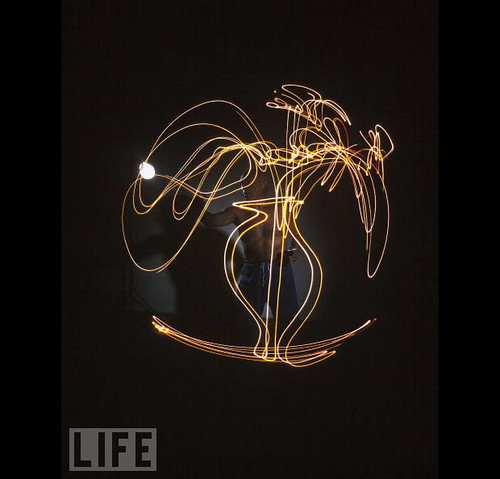
Picasso: Drawing with Light

Today, rather than share with you what I recently read in a book, I'm going to share an image feed of a series of pictures that I came across in Life Magazine.

LIFE photographer Gjon Mili visited Picasso in 1949. Mili showed the artist some of his photographs of ice skaters with tiny lights affixed to their skates jumping in the dark—and Picasso's mind began to race. The series of photographs that follows—Picasso’s light drawings—were made with a small flashlight in a dark room; the images vanished almost as soon as they were created.


Aren't these images absolutely terrific?